Three Endangered Tigers Spotted In Western Thailand
Conservationists in western Thailand have confirmed the capture – on film –…
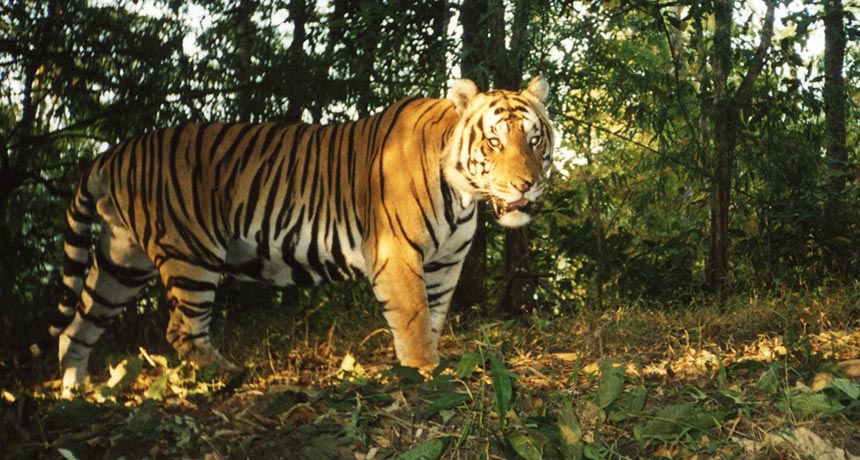
Conservationists in western Thailand have confirmed the capture – on film – of a number of the region’s endangered tigers for the first time in four years.
It is thought there are only around 160 wild tigers remaining in Thailand, of just 3,900 wild tigers around the world.
100 years ago, this number was thought to be as high as 100,000.
The footage was captured on several remote camera traps earlier in the year, and seems to show three male Indochinese tigers.
“In a sea of news casting doubt on the future of our planet’s wildlife, this development is a welcome sign of hope and potential turning of the tide for the endangered tiger in Thailand,” said John Goodrich, the chief scientist and Tiger Program Director for Panthera, one of the four agencies involved in the monitoring program.
The others are Thailand’s Department of National Parks, Wildlife and Plant Conservation (DNP), and the Zoological Society of London (ZSL).
“We believe they are quite young and think they are all males,” said Chris Hallam, Southeast Asia regional coordinator for Panthera, the global wild cat conservation organization.
It is believed the tigers have moved away from a previously fixed breeding population further inside Thailand to a site closer to the border with Burma to the west; an indication the area is remote enough from human activity, and with enough prey to sustain the tigers’ presence.
“We don’t know that they are definitely settled down in that area, but we are monitoring them closely,” Hallam added, before saying it was a sign of “the recovery of an area that historically would have had tigers and is now sort of welcoming them back.”
Once seen in relatively large numbers across Asia, tigers have seen their numbers devastated in China, Cambodia, Laos and Vietnam with several populations already confirmed as extinct, and others endangered.